Reckoning at the Etihad: Unpacking City’s Guilty Verdict and the Soul of the Premier League
For years, the phrase "115 charges" hung over English football like a permanent shadow, a quiet asterisk attached to every trophy lifted, every record broken, and every masterclass executed by Pep Guardiola’s side.
That shadow finally broke into a full-scale earthquake.
Following an exhaustive multi-year investigation and a landmark hearing before an independent commission, the Premier League published its official verdict: Manchester City has been found guilty of 114 out of 115 charges.
City quickly responded by lodging a comprehensive appeal, contesting the commission’s findings and citing "clear errors" in the decision. But regardless of how the appellate process unfolds in the coming months, English football has crossed a threshold. The illusion of untouchability is gone, and the future of the Premier League will never look quite the same.
Unpacking the Verdict: The Scale of the Violations
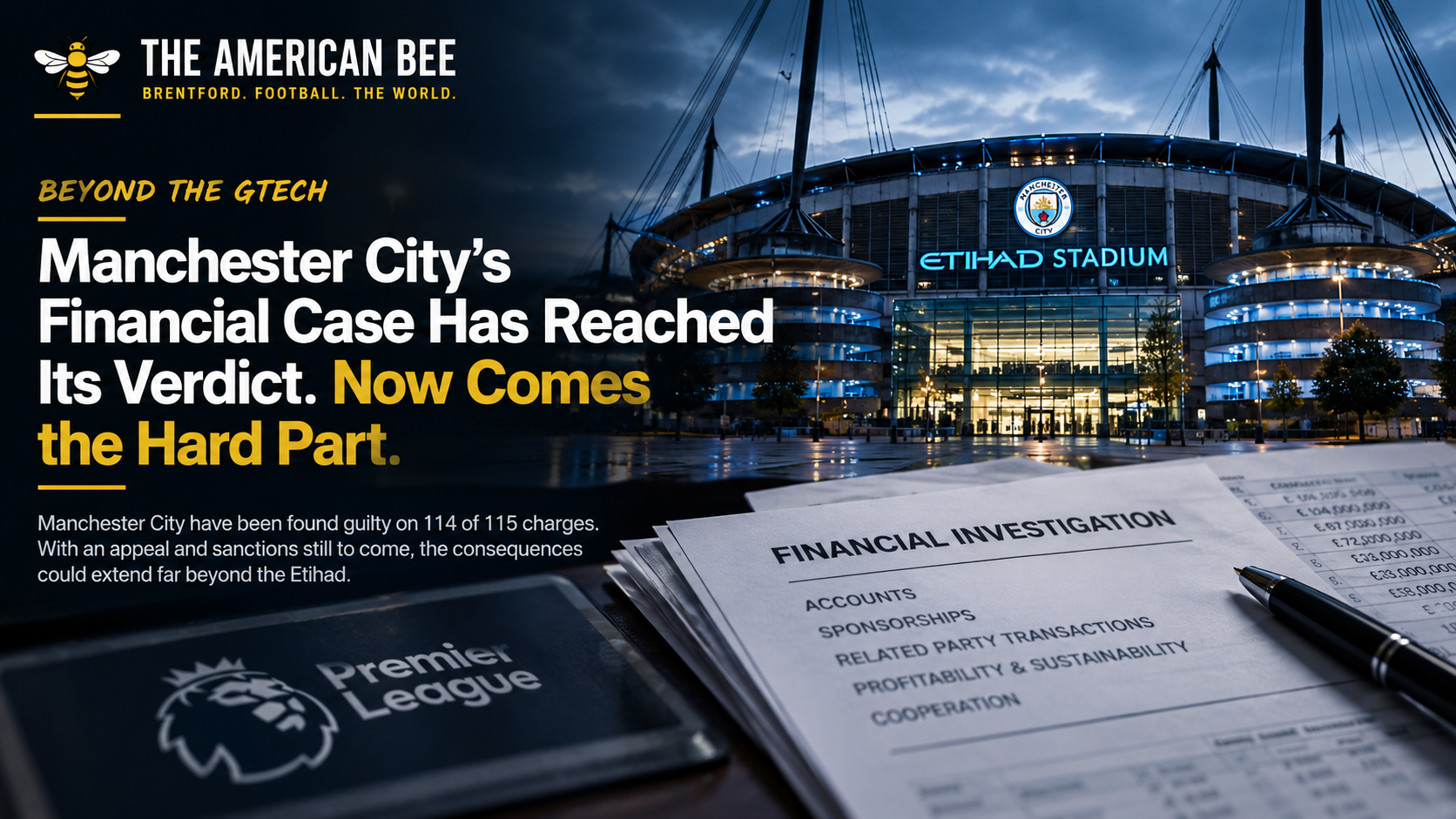
To understand the magnitude of this decision, you have to look at how the commission broke down the charges:
80 Financial Breaches (2009–2018): The core of the prosecution. The commission found that over a nine-year period, City systematically failed to provide accurate financial information. This included underreporting executive and player remuneration (off-the-book payments), disguising owner equity funding as legitimate third-party sponsorship revenue, and failing to comply with UEFA’s Financial Fair Play regulations.
34 Non-Cooperation Breaches (2018–2023): The league found City guilty of obstructiveness over a five-year investigation, failing to supply required documents, delaying proceedings, and refusing to cooperate in good faith.
The Single Acquittal: City was cleared on just one charge relating to cooperation protocols during a specific accounting window.
This wasn't a administrative technicality or a minor oversight in paperwork. The commission’s findings describe a sustained, multi-year effort to circumvent the financial architecture that governs the world’s most popular sports league.
At the heart of the financial case was the commission’s finding that Manchester City used what it described as “sham” commercial agreements. The Premier League says the commission found that a number of sponsorship arrangements did not reflect the true financial agreements between the parties. According to the commission’s findings, companies paid only part of the stated sponsorship fees, while the remainder was funded by Abu Dhabi United Group Investment and Development Ltd, the company that owned Manchester City during the relevant period.
The purpose, according to the commission, was to artificially increase recorded revenue and reduce reported costs by more than £900M (just shy of $1.2B) over the affected period. The league says that caused City to submit misstated accounts and conceal the true state of their finances from auditors and football regulators.
Manchester City has maintained throughout the case that it is innocent and says it possesses what it describes as a comprehensive body of evidence supporting its position. Following publication of the commission's decision, City said it believed the judgment contained material errors of law, principle and fact.
This is Not the End of the Case
Manchester City formally appealed the independent commission's findings on October 1.
The appeal will be heard by an independent three-member Appeal Board appointed by the chair of the Premier League's Judicial Panel. The hearing will be private, as was the original commission hearing.
The Premier League's current rules give an Appeal Board considerable discretion. It can dismiss an appeal, allow it, refer matters back for further consideration, or vary an order made by the commission.
Under the league's new fast-track provisions, the appeal hearing is supposed to take place within 12 weeks of the appeal being lodged, with a decision due within 30 days of the hearing concluding. In other words, the appeal process has the potential to take the story into January 2027, although the proceedings themselves are confidential.
And, crucially, no sporting sanction has yet been imposed.
That is a distinction worth emphasizing, because an awful lot of discussion around this case has jumped directly from “guilty” to “relegated.”
Those are not the same thing.
What Could Happen to Manchester City?
This is where things get particularly interesting.
The Premier League's disciplinary rules give an independent commission broad powers when a complaint is proved. Those powers include an unlimited fine, a points deduction, suspension from playing league matches, a recommendation that the club be expelled from the Premier League, compensation to another person or club, cancellation or refusal of player registration, and combinations of those penalties or other sanctions.
There is no published fixed tariff for a case of this nature.
That means anyone confidently predicting a specific points deduction right now is making a prediction, not reporting an established outcome.
The same applies to relegation.
Relegation is possible under the league's disciplinary framework because suspension and expulsion are among the available sanctions. But the commission has yet to determine the punishment, and Manchester City's appeal against the liability finding remains outstanding.
The possibility of retrospective consequences also hangs over the case. City won three Premier League titles during the nine-season period covered by the financial charges. Whether any historic titles, league positions or other sporting outcomes are revisited is a separate question from whether the club is found in breach of the rules. The published core decision establishes liability; it does not itself rewrite the historical record.
That is why the sanctions hearing may prove almost as consequential as the verdict itself.
Perhaps the strangest part of this entire story is that the Premier League is now operating under a different financial system than the one at the center of the City case.
Beginning with the 2026/27 season, the old Profitability and Sustainability Rules were replaced by a new framework built around Squad Cost Ratio (SCR) and Sustainability and Systemic Resilience (SSR). The SCR system regulates on-pitch spending to 85 percent of football revenue plus net profit or loss on player sales, with additional multi-year spending allowance available under the new framework. SSR adds financial-health tests covering areas including liquidity, working capital and equity.
For American football and sports fans, it is worth emphasizing that this is not the equivalent of an NFL-style salary cap. The Premier League's system is built around financial sustainability, accounting, revenue and spending rather than a single league-wide payroll ceiling.
And that makes the City case even more important.
The regulations have changed, but the basic question has not: Can the league enforce its financial rules when one of its biggest and most powerful clubs is accused of breaking them?
Why Fair Play Matters to the Rest of Us
As a Brentford supporter watching this from across the Atlantic, it’s impossible not to process this verdict through the lens of what happens every weekend in West London.
Clubs like Brentford operate on razor-thin margins. Every pound spent on wages or scouting at the Gtech Community Stadium is scrutinized, budgeted, and backed by data-driven sustainability. When Brentford beats a Big Six giant, it feels like a victory for smart recruitment, tactical discipline, and genuine sporting merit.
When financial rules are bypassed, it distorts the entire pyramid:
Inflated Transfer Markets: Artificially expanding budgets pushes transfer fees and wage demands to levels that organic, self-sustaining clubs cannot touch.
European Qualification Bottlenecks: Every European spot or domestic trophy claimed through financial engineering is a spot denied to a club operating strictly within the rules.
The Illusory Level Playing Field: Profitability and Sustainability Rules (PSR) lose all legitimacy if the consequences for breaking them only apply to mid-table clubs facing point deductions while sovereign-backed superpowers tie up regulators in court for years.
For fans here in the United States, watching European football’s financial drama can feel surreal. American sports leagues are built entirely around competitive balance, salary caps, luxury taxes, revenue sharing, and reverse-order drafts designed to prevent dynastic monopolies.
European football, by contrast, has always embraced a free-market ethos balanced by financial guardrails. But when those guardrails fail, the entire system collapses into an arms race of unconstrained capital.
For the Premier League to maintain its massive global appeal, especially here in the U.S., where fans tune in precisely because "any team can beat any team on its day,” there must be faith that the game is played on a fair pitch. Without enforcement, the Premier League risks becoming less of a sporting competition and more of a geopolitical accounting exercise.
What Lies Ahead
The coming months will test the governance of English football to its absolute limits. As City’s legal team prepares its appeal, Chief Executive Richard Masters and the Premier League board face the delicate task of protecting the league's brand while proving that no club is too big to fail.
Whether this process ends in historic points deductions, expulsion, or unprecedented fines, one thing is certain: the era of financial impunity in English football has come to an end.
For clubs like Brentford, and for millions of supporters around the world who still believe in the magic of unscripted sporting merit, that is a fight worth having.
Come On You Bees! 🐝
Posted: October 3, 2026 @ 7:52 AM EST
